

.png)
Khalte, a settlement close to the bank of the Trishuli River in northern Nepal, was completely destroyed in the flash flooding of late August. Khalte housed around 257 families who had been displaced by a previous disaster, when Nepal was rocked by a 7.8-magnitude earthquake in 2015.
I spent time working with families there in September 2019, as part of a research project looking at how renewable energy might improve their lives. This community had spent years living in makeshift homes squeezed between the river and the road, on land that was known to be at risk of flooding.
Having lost almost everything in the earthquake, they were scraping together a living from a mixture of casual reconstruction work and agricultural labour. They supplemented this meagre income with rice and vegetables grown on small plots dotted along the river bank.
One thing people said they needed was lighting – particularly outside, where darkness made moving around the settlement difficult. Our research team worked with the community to install solar-powered streetlighting – even as giant pylons towered above the settlement, taking electricity from the Chinese-sponsored Upper Trishuli-3A Hydropower Project to the crowded streets of Nepal’s capital Kathmandu, 60 miles downstream.
The river kept warning themKhalte was never meant to be somewhere people should stay. An official geo-hazard assessment conducted by Nepal’s National Reconstruction Authority in early 2018 declared it an unsafe place to live due to the risk of flooding, landslide and debris.
Residents understood this too. As families were moving into Khalte, they were warned by local residents that the Trishuli had previously flowed across the area where corrugated homes were being constructed, and could do so again. One resident told researcher Kerstin Rieger of the risks in 2018: “For me, Khalte is not safe. If the river level increases, then it can take the camp. Everyone can see this.”
But attempts to move the residents stalled, even as the river kept reminding them of the danger. The swollen Trishuli repeatedly burst into the settlement itself, with one resident telling the Kathmandu Post in 2022: “We cannot sleep well during the monsoon season. We stay awake when it rains heavily.”
Three years later, in July 2025, a sudden glacial lake outburst sent flash flooding into northern Nepal from across the border in Tibet. That flood killed at least nine people in the region, and caused people to run for higher ground as homes were washed away. Yet still people stayed in Khalte.
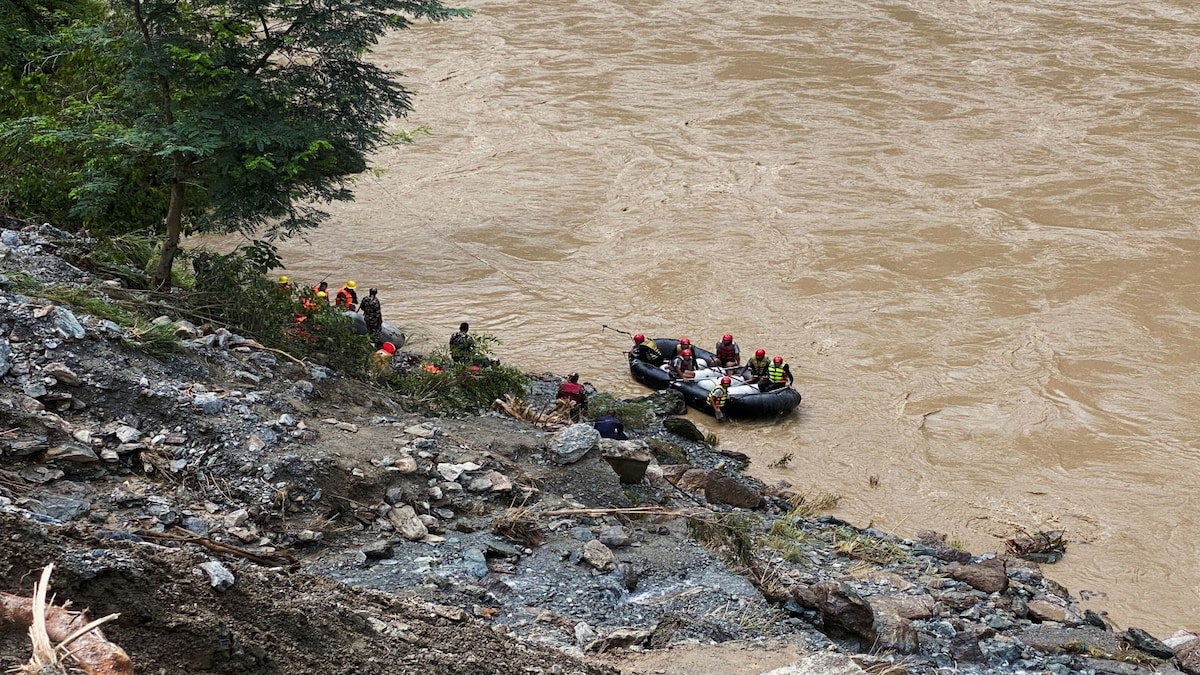
Then, on August 26 2026, disaster struck. A mass of ice broke away from a glacier near the Nepal-Tibet border and dammed the Lhende River. When the dam gave way, a wall of water swept through through the valley, taking with it homes, roads, land and hundreds – if not thousands – of people. Many people remain buried under the mud.
Khalte no longer exists. All 257 houses were destroyed, and dozens of the people who lived there are still missing. Rescuers are frantically searching for survivors in nearby villages and hydropower tunnels.
Protracted displacementKhalte was far from the only community devastated by these floods. But the fact the people living there had been unable to find a solution to their displacement more than a decade earlier carries lessons that governments and international organisations should learn from.
Resettlement plans were repeatedly stalled due to bureaucratic delays, financial constraints and inadequate resettlement alternatives, which ignored the community’s cultural and livelihood needs. Returning meant going back to villages still exposed to landslides. Life in Khalte was dangerous, but the alternative wasn’t safe either.
Khalte is just one example of a much larger global problem. According to the Internal Displacement Monitoring Centre, 83 million people were internally displaced within their own countries at the end of 2025, unable to return home or establish themselves somewhere else, sometimes for years or decades.
More than half – a staggering 45 million people – have been displaced by the effects of climate change. As the climate crisis worsens, many more people are likely to lose their homes due to extreme weather events, heat, fires, floods and other hazards.
Preventing another Khalte requires action on three fronts. First, governments need to ensure that people displaced by one disaster are not resettled into the path of another. That means planning for earthquakes and landslides as well as the growing risks associated with extreme rainfall, glacial retreat and flooding.
In remote rural areas, deaths can be reduced by establishing effective, community-based early-warning systems – but not if displaced communities are resettled directly in the path of the oncoming threat. In Khalte, local officials raced down to the settlement in an ambulance, using a loudspeaker to warn riverside residents to evacuate. However, they too were swept away.
Second, relocation needs to offer people a viable future, not just a safer house. The experience of Khalte shows why access to farmland, employment, schools, services and social networks matters. People will struggle to leave dangerous places if doing so means losing the means to support themselves.
But the responsibility cannot rest with Nepal alone. The climate crisis is a crisis of injustice. Those least responsible are often the first and worst affected, and all too often are the least equipped to recover. Nepal produces just 0.1% of global greenhouse gas emissions, yet it faces growing risks from floods, landslides and glacial hazards.
Wealthier countries and international institutions have a responsibility to provide sustained finance for adaptation, resilient infrastructure and planned relocation. This is needed before communities are destroyed, rather than offering humanitarian assistance after disaster strikes.
Looking now at the photographs I took in Khalte seven years ago – families outside their homes, washing on the line, vegetables growing beside the river – it is difficult to reconcile the place I remember with the empty riverbed left behind by the flood, or to know how many of the people I met are still alive.
The lesson of Khalte is that surviving one disaster should not leave people more vulnerable to the next.
Heaven Crawley has previously received funding from UKRI.

 (1).jpg)
 (1).jpg)
 (1).jpg)
 (1).jpg)